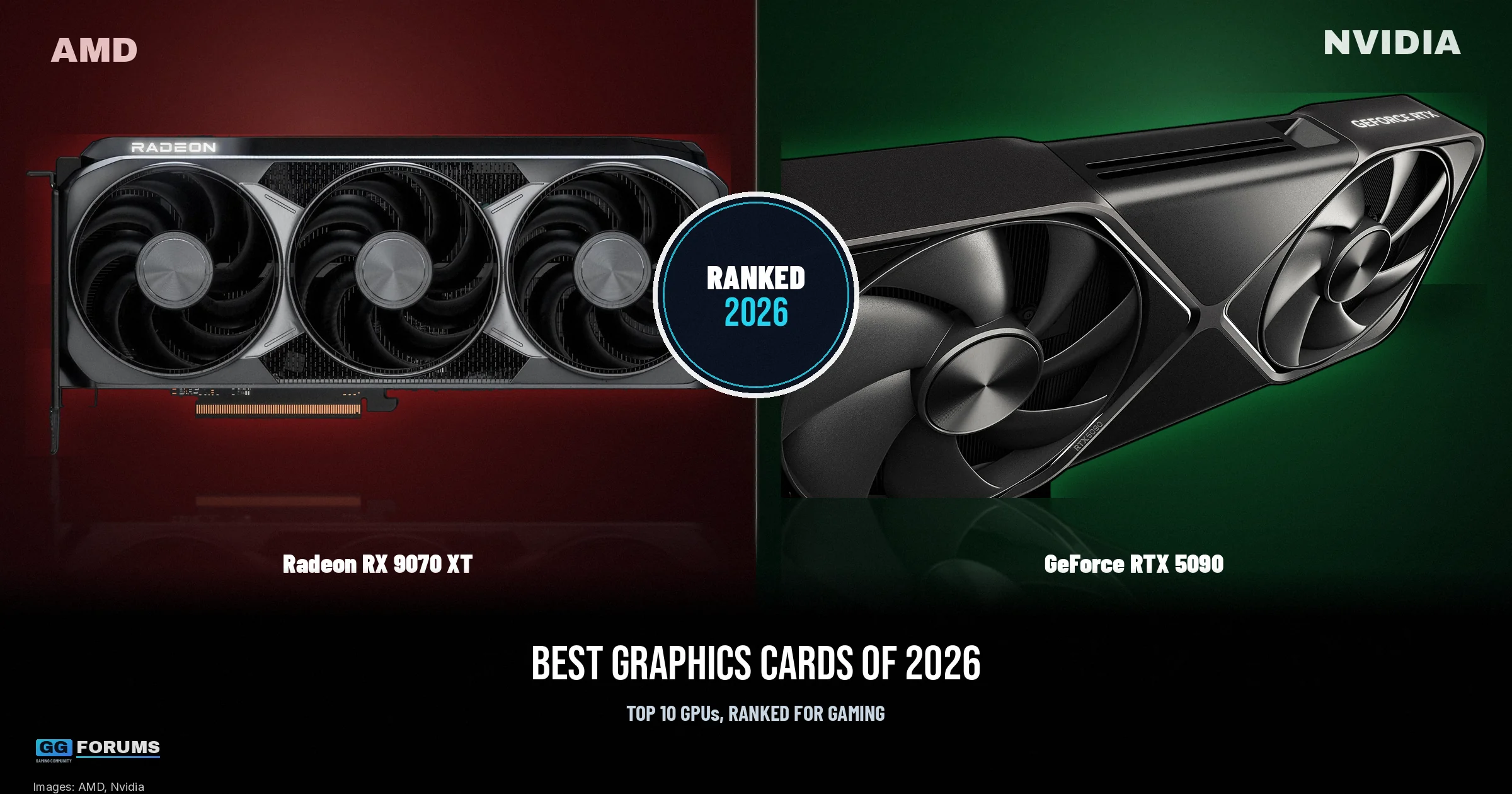
- Note: Prices are stratospheric, and as of November 5, 2026, reputable sellers were already out of stock. This is the halo card. Do not chase one this week. See the Nvidia GeForce RTX 50 lineup guide.
- Verdict: The fastest card you can buy, at 1080p, 1440p, and 4K. Buy it only if money is no object.
- Note: November 2026 prices were far above the 5070 Ti, so buy it only if that gap is worth the premium. See the Nvidia GeForce RTX 50 lineup guide.
- Verdict: The best 4K card if you will not pay 5090 money. Late-2026 testing found it about 8 to 16 percent faster than the RTX 5070 Ti, with the biggest gap at 4K.
- Note: DLSS 4.5 is more widely adopted than AMD's FSR, which is the reason to pay Nvidia money at this tier. See the Nvidia GeForce RTX 50 lineup guide.
- Verdict: The high-end Nvidia buy if you want DLSS 4.5 and 16 GB without stepping up to a 5080. In baseline testing it is only a little faster than the RX 9070 XT, and it costs a lot more right now.
- Note: If you want 4K performance without 5080 pricing, start here. See the AMD Radeon RX 9000 lineup guide.
- Verdict: The best high-end value, and the cheapest current way into native 4K 60 fps. A 2026 update found it about 24 to 25 percent faster than an RTX 5070 at 1440p and 4K, with 16 GB versus 12 GB.
- Memory: 16 GB of VRAM, close to the XT in a lot of 1440p testing, and it beats the RTX 5070.
- Note: Buy the XT if you want native 4K. See the AMD Radeon RX 9000 lineup guide.
- Verdict: The best card for most people. Buy this if you play at 1440p and want the best raster value in the stack.
- Memory: The 12 GB buffer is a real limit at this price.
- Note: Buy this only if you specifically want DLSS and cannot get a 9070 or 9070 XT. It is close to the RX 9070 at 1440p, weaker at 4K, and a distant third for 1440p value. See the Nvidia GeForce RTX 50 lineup guide.
- Verdict: Skip it if the 16 GB 9070 XT is cheaper and faster, which it often is.
- Note: It fights the RX 9060 XT 8 GB, $299 MSRP, for performance per dollar at 1080p, and this is the one case where an 8 GB card is still a reasoned recommendation. The 16 GB 5060 Ti exists, but its street price can climb past faster cards. Do not buy the 8 GB model if you want 1440p headroom. See the Nvidia GeForce RTX 50 lineup guide.
- Verdict: The midrange / 1080p value pick.
- Note: The 8 GB version is the 1080p-value fight with the RTX 5060 Ti 8 GB. Do not mix them up. See the AMD Radeon RX 9000 lineup guide.
- Verdict: AMD's current midrange 16 GB card, and the one to buy in this band if you want memory headroom for 1080p to entry 1440p.
- Note: Nvidia's non-Ti 1080p card. It sits below the 5060 Ti, and it is not a 1440p card. See the Nvidia GeForce RTX 50 lineup guide.
- Verdict: Buy this if the 5060 Ti is out of reach.
- Note: Stretch to the B580 rather than settle for the cheaper B570. See the Intel Arc lineup guide.
- Verdict: The best current Intel gaming GPU, and the entry-level pick if you need to save.
- If a 5090 listing looks too good to be true, walk away. It is not a normal retail card. Reputable sellers were already out as of November 5, 2026.
- Do not assume any current card is selling at its original MSRP. Prices are inflated from the top of the stack to the bottom. The right card is often the one you can actually afford.
- Do not treat 8 GB of VRAM as an automatic deal-breaker at 1080p. 8 GB is fine in most cases at that level. The trap is buying a midrange or 4K-priced card with a small VRAM buffer when a 16 GB card in the same band costs less. That is the 5070 problem above.
- If you are watching stock and street prices, we already have two threads in PC Tech Talk on Nvidia supply cuts and the recent price spike. Use those threads for the market, and this one for what to buy.